Friday, June 8, 2018

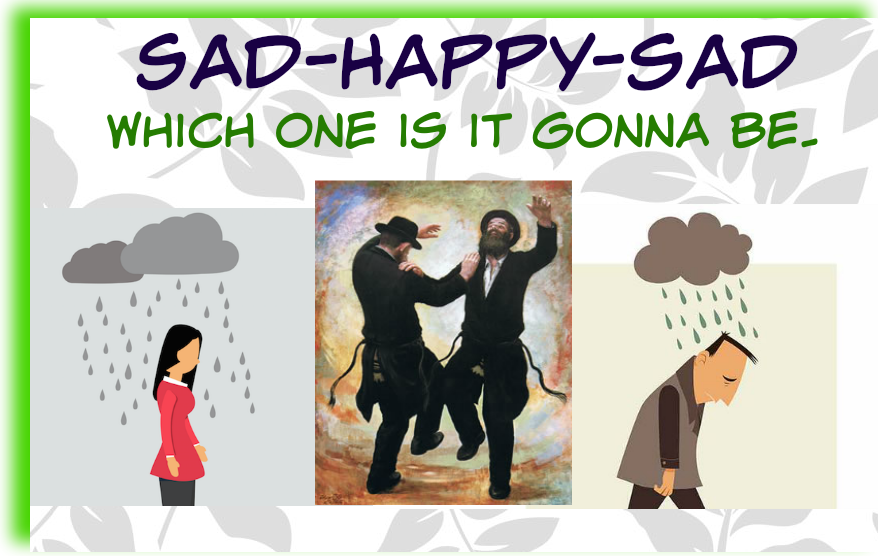
Depression -- and Joy.


One of the most successful tactics of the evil inclination inside each one of us, is to cause a person sadness and worse yet, depression. When one is tired and weary, he makes his move to bring the person down even further. Not only with doing foolish things, but worse yet, the guilt that follows afterwards.

In the Holy book of the Tanya, he writes that the only way one is able to be victorious over the evil inclination is with Simcha - enthusiasm and joy, which is not tainted by any worries or sadness. The Tanya compares this, to two people fighting. Even if one is naturally stronger, the weaker one (the evil inclination) will defeat him if he lacks joy and enthusiasm.

The G-dly inclination inside every person is the spark of G-dliness, and is compared to light. By Nature, naturally, a small quantity of light will chase away much darkness, but the person must be happy and joyous. I did not say he must enjoy himself, I said, he must find joy in his life. 

This is one of the very powerful reasons why, the first acknowledgment we make as we open our eyes every morning, is gratitude to G-d, for returning our souls to us. This demonstrates G-ds faith in giving us another day to fulfill and accomplish. 

The spirit of internal strength, the flow from ones soul – the internal candle - does not shine on someone who is sad or downhearted.

The book of the prophets tells us a story, that when Elisha became angry with Yehoraam the king for his wicked ways, the spirit of prophecy left him. It was only after music was played for him, and his mood was lifted, that his spirit of prophecy returned.

The Talmud says a story, that once there was a Rabbi walking around in the market place when he happened to notice Elijah, the prophet. The Rabbi asked the prophet, was there anyone in the market place who merited paradise. The prophet answered in the negative. Soon, two brothers entered the marketplace, and Elijah pointed to them saying, “These will merit the world to come”. The Rabbi went over to them and asked, what their occupation was, and they said, “We are joyful people, and we make those who are sad happy. If we hear an argument, we make peace using humor between those quarrelling.”

In the book of mysticism, the Zohar, it says….. The way we act here in this world, is the way we are dealt with from above. When a person acts in a happy, joyous, grateful, relaxed, and open mind-set, G-d will deal with him in the same way, in a happy and joyous way.

Once, a great Rabbi crossing over a bridge saw a man struggling to save himself in the waters below. Seeing no way that he could save the fellow, he called out, “send regards to the big fish (Leviathan) at the bottom of the river”. At that moment – G-d came to the fellows’ aid, and the fellow was able to catch onto a plank of wood and save himself. 
The Rabbi later explained that due to the man’s broken spirit, he could not be helped. “When I made that foolish funny comment – in that moment of distraction, he was able to save himself with the power of the joke”.

“The mind is always working”. A person should consciously try to keep his mind occupied with things to accomplish, so he does not have the time, and does not give his mind the chance to think sad thoughts. 

When the evil inclination comes to a person and tries to persuade him with all kinds of foolish arguments that he has every reason to feel sad, the person must respond without entering any logical arguments. “You are bad and trying to trick me, even if what I did or who I am isn’t perfect, I have an obligation to always be happy” and immediately divert his mind to positive and uplifting thoughts AND NOT LOOK BACK. 

Friday, February 23, 2018

Grinding out the Light


You can change the entire World with; Only One Thought


You can change the entire World with; Only One Thought

The influence of thought on our surroundings is observed in many ways. This has been established to some limited degree with machines that measure brainwaves recorded either directly or through the scalp.

According to Jewish Law, a person is not allowed to think holy thoughts of prayer or of the Bible in an unclean place. A person's thinking interacts with his outside surroundings and, it is disrespectful to the holy thoughts and a conflict with the uncleanliness of the place he is in.

A person is not allowed to think badly of an otherwise genuine person. The mere reservation of trustworthiness is considered wrong and harmful to that individual. Even worse, for both parties, is to hate in your heart and bear a grudge.

The Talmud tells us that when the Bible character, King Balak, brought sacrifices to curse the Jews, his bad intentions brought a harsh punishment years later, and his good deeds, the sacrifices to G-d, generated the reward that King David and King Solomon where his progeny!

While on the subject of sacrifices...if a person brought a sacrifice and, in his mind, he was thinking an intentional wrong thought, to eat the sacrifice outside the allotted time or place where the sacrifice must be eaten, this would invalidate the offering.

The Rambam/Maimonides says, a person should always see himself as half-meritorious and half-contemptible, and with even one thought, he can tip the world to the positive or to the negative.

A person's thought can influence and tip the entire Universe for the good.

The Talmud further says that in one moment a person can make an about face from where he is, he can think and regret his past misdeeds. In that one moment, his status changes from being considered an evil person, and he can become righteous!! Saying he is sorry mechanically accomplishes nothing. It is specifically his thoughts of regret, and his sincere resolution to look in another direction from now on, that transform the person status, entirely.

One of my teachers sent to hard labor for eight years remembered how his spiritual teacher once said that all those who were in the Russian gulag for teaching Judaism should intensely connect in their thoughts, and he would reciprocate.

So, at the first possibility, he closed his eyes and envisioned himself in a private audience with the Rebbe giving him a letter regarding his situation. The Rebbe actually responded with a letter!

When his wife received this letter she first thought he successfully escaped and soon would be reunited only to discover that he was still in the hard labor camps. It was only years later seeing the date on the letter did the whole story fall into place. Think positive, think faith and transform your world. Transform the entire universe.

Monday, December 11, 2017

The Great Strength and Power of the Chanukah Lights


Rabbi Levi Yitzchok of Berditchev (1740–1809) was asked. “Why did the sages institute the holiday of Chanukah to commemorate the miracle of the Hasmonean (Maccabees) victory over the Seleucid Army, and a Holiday of Purim to commemorate the victory of Mordechai and Esther over Haman and the Persians, while no holiday has been established to remember and celebrate the victories that happened long before these two, with the prophetess Deborah and Barak over Sisera, or the miraculous victory of Yechezkel the King over Sancheriv?

The Rabbi answered. There are miracles which blast away the rules of nature through a greater involvement of G-d in those events, but they are temporary and fleeting. Then, there are shines of G-dliness that are so powerful, they penetrate into the actual fiber and character of the day forever, and remain embedded in the day, to connect, and draw from this power every year, and such is the miracle of Chanukah and Purim.”

Just like there are foods that are worn out on us in a few hours, and then there are vaccines we introduce into our bodies that can last a lifetime. Certain influences of G-d are onetime events, and other inputs of G-dliness which are eternal.

This is the deeper meaning of the blessing we make when lighting the Chanukah Menorah every night for eight nights, “who performed miracles for our forefathers in those days, at this time.” The miracle of Chanukah that happened at that time, is available and shining again at this time!!”

Some people may be walking around with “paper” in their pocket not realizing each and every paper is a hundred-dollar bill. As a result, they may misuse this paper not using the “paper bills” to its full potential. Some people may see shiny rocks and stones on the ground not realizing the value in those stones. The same is also with certain days, and time.

Like objects, certain days and certain times of the day are more inclined to certain opportunities. The seventh day of the week, Shabbat, when observed properly has the strength and qualities to literally become a retreat in time, a vacation without the bills and traveling headaches. Unlike any other day of the week, Shabbat i.e. the seventh day of the week has in its DNA the possibility to give one observing this G-dly day, a true deep soul rest, tranquility and peacefulness.

Rabbi Nachman of Breslov (1772 – 1810) once said. “Through the lighting of the Chanukah lights” (at the proper times, and making the suitable blessings etc.) one draws into their life, into their soul, and into their world the infinite light of G-d. The kind of light that we pray for, “the Lord make His countenance shine upon you, and be gracious to you.”

When the lights shine, and there is less darkness, we are able to see where to go and what to avoid. We can see in clarity what is good and what is not so good. The negative forces thrive in darkness and run away from light. The holy Baal Shem Tov had a very strong affinity for light and would say. “In Hebrew the word for “secret” is the same numerical value as “light”. Whoever has “light” (as in, the candle is a Mitzvah, and Torah is light), knows the secret.” Life has less secrets, and more of the truth and reality is uncovered.

The MIRACLE of Chanukah was and is, all about the few and the holy who would not buckle in to the many, and the impure. Today, we are not remembering the ones who in weakness blended in and assimilated. The story and the holiday of Chanukah is a commemoration and tribute to those who believed and dedicated their lives for the purpose of their faith. It is in their merit; we today can still identify ourselves with our faith. It is in their merit, G-d made the miracle of Chanukah and we benefit from the infinite light of our candles.

Proper Speech.


Tuesday, December 5, 2017

A poor person with a mentality of gratitude is wealthier than a person with more money.


Knowledge is Power -- G-dly Knowledge is SUPER POWER.

The prophet Jeremiah admonishes, “let not the wise man glory in his wisdom, let not the mighty man glory in his might and let not the rich man glory in his wealth; but let him that glories, glory in this, that he understands and knows me for in these things I delight says the Lord.”

According to our sages, everything is determined up in heaven except for the choices a person makes between good and the opposite. Wisdom, might, wealth are gifts from G-d. There is no place for a person to glorify himself in those things that are granted to him, so they can support and help him accomplish in those areas where he really does have input and influence.  The only area in life a person can justifiably take personal credit and pride in, are those choices a person makes when he decides the righteous moral and good path over the alternative.

Ben Zoma declares however that certain types of wisdom, might and wealth, may properly be prized and gloated over only, once they are integrated in the concept of “understanding and knowing me”.  And he says.

“Who is wealthy, and may justly acknowledge his wealth?  He who can bring himself to mentally and emotionally be thankful to G-d, and happy with his lot.  “Happy shall you be in this world, and it shall be well with you in the world to come.”

G-d created a nature within humans that we quickly become habituated and adapted with our circumstances in life. We become comfortable with our families, our health, our environment and our condition in life. There is an old saying. If G-d showed us the whole picture of anyone else’s life, all its’ pluses and minuses, the overwhelming majority of people would choose precisely where they presently are.

This is good because by becoming accustomed to what we have, the irony is, this is what creates the desire to explore and desire more.  To experience something fresh and novel.

On the other hand, once a person starts to intensely focus on more, many times this will cause people   to lose their appreciation and gratitude for all the good and all the blessings they already have been blessed with.

Ben Zoma teaches us to live in the now. When people become seriously driven and focused on the future, many times this has a tendency to put people under tremendous stress and in a state of worry and anxiousness, and they may feel responsible for things that are not under their control. In addition, they live in the past, which many times brings feelings of guilt and personal blame.

The proper balance is when we live and are focused mostly on the now, as the Rambam teaches, “a person should view every day as if it where his last day.”  The Talmud teaches, “whoever has bread for today and is worried about tomorrow he is from the small believers.”  We are grateful and appreciate the present, while aspiring for more in the future.

In is interesting that we begin every day and our morning prayers start with an expression of thanks and gratitude, and only a few minutes later we are asking for more!  It is from this foundation of thanks, that it is healthy to ask and seek more.

A person who is constantly aspiring and dreaming for more and forgetting the present will never be satisfied. When he finally gets what he wants, he is still hoping for more, and always feels lacking. With this mentality, a rich person with $200 who seeks to double his wealth, is poorer than a poor person with less money, since the feelings of lacking in the rich person is greater. A poor person with a mentality of gratitude is wealthier than a person with more money.

Not being caught up in this cycle of always wanting more, maintains inner peace and calm, and a person at peace with himself is far more able to take advantage of opportunities, when they present themselves.

Sunday, November 19, 2017

Giving it ALL you got and the positive in the struggle.


Sarah passes on and her husband Abraham is looking for a burial site to fulfill his obligation to bury his wife. Abraham didn’t even consider cremation, since that would be the greatest disrespect to her life and the greatest punishment to her soul.

Abraham decides he would like to buy land in Hebron from Efron, and Efron offers to give the land for free, as a gift. Abraham would not hear of it and insisted he wanted to pay for the land. Efron offers to sell the land for its full value, 400 silver talents and Abraham purchases the property – no haggling -- and buries his wife Sarah.

Abraham did not want that there should be in the future the slightest claim on the land from Efron or his people if he would accept the land as a gift, therefore he compensated Efron to the last penny that was requested for the land. In doing so, the land was totally acquired by Abraham for both Sarah and Abraham and all his future children.

The bible says Efron referred to Abraham as “a G-dly prince in our midst”. Abraham was a special and important person amongst the people of that time. The law is, when an important person accepts a gift from someone, the honor and pleasure received by the giver, is considered as a form of currency and exchange that the important person is giving, a sort of a barter, for the gift granted to him,

Abraham as an important person, had he accepted the land as a gift this would have been his form of payment for the land to Efron. Why did he still insist in paying the full price in cash?

Here we have a great secret and lesson in life.

It is true that had Abraham merely accepted the land from Efron this would have totally severed any claims to the land by Efron by virtue of the gift accepted by Abraham. However, Abraham would not have paid any money and this is something Abraham did not want to do.

True service to G-d and worthwhile accomplishments in life must come necessarily through hard labor. Anything that comes by itself or without sacrifice, remain external and superficial to our lives. Without working hard for something, what we acquire will not be permanent and doesn’t have any real inherent value and appreciation in our lives.

Abraham insisted to pay full price for the burial site because he understood, “a man (to be happy and fulfilled) is born to toil”, he must earn his keep.

Everything in this world has a spark of G-dliness, and therefore potential blessing waiting to be redeemed when it is used in the service of G-d. The more we utilize what G-d created specifically through sacrifice and difficulty, for the good, the more we free goodness in the world.

The way to involve our own lives and actual bodies in this process and bring the best of blessings and health in our own lives and thereby connect deeply with the act is when we toil in hard labor to bring about good. “With the sweat of your brow you will eat bread.” There is an inherent positive value -- more is absobed into and for your own life -- in working hard and plugging away to accomplish results in life.

Mysticism teaches, “Free bread is shameful bread.” The great AriZal always insisted in paying full price for his Mitzvot- (G-dly deeds) and taught,  the sweat one experiences when doing good deeds cleans the dirt of one’s soul.

Falsehood.


Sunday, November 12, 2017

Cremation?? Giving it ALL you got and avoiding gifts...


Sarah passes on and her husband Abraham is looking for a burial site to fulfill his obligation to bury his wife. Abraham didn’t even consider cremation, since that would be the greatest disrespect to her life and the greatest punishment to her soul. 

Abraham decides he would like to buy land in Hebron from Efron, and Efron offers to give the land for free, as a gift. Abraham would not hear of it and insisted he wanted to pay for the land. Efron offers to sell the land for its full value, 400 silver talents and Abraham purchases the property – no haggling -- and buries his wife Sarah.

Abraham did not want that there should be in the future the slightest claim on the land from Efron or his people if he would accept the land as a gift, therefore he compensated Efron to the last penny that was requested for the land. In doing so, the land was totally acquired by Abraham for both Sarah and Abraham and all his future children.

The bible says Efron referred to Abraham as “a G-dly prince in our midst”. Abraham was a special and important person amongst the people of that time. The law is, when an important person accepts a gift from someone, the honor and pleasure received by the giver, is considered as a form of currency and exchange that the important person is giving, a sort of a barter, for the gift granted to him,

Abraham as an important person, had he accepted the land as a gift this would have been his form of payment for the land to Efron. Why did he still insist in paying the full price in cash?

Here we have a great secret and lesson in life.

It is true that had Abraham merely accepted the land from Efron this would have totally severed any claims to the land by Efron by virtue of the gift accepted by Abraham. However, Abraham would not have paid any money and this is something Abraham did not want to do.

True service to G-d and worthwhile accomplishments in life must come necessarily through hard labor. Anything that comes by itself or without sacrifice, remain external and superficial to our lives. Without working hard for something, what we acquire will not be permanent and doesn’t have any real inherent value and appreciation in our lives.

Abraham insisted to pay full price for the burial site because he understood, “a man (to be happy and fulfilled) is born to toil”, he must earn his keep.

Everything in this world has a spark of G-dliness, and therefore potential blessing waiting to be redeemed when it is used in the service of G-d. The more we utilize what G-d created specifically through sacrifice and difficulty, for the good, the more we free goodness in the world.

The way to involve our own lives and actual bodies in this process and bring the best of blessings and health in our own lives and thereby connect deeply with the act is when we toil in hard labor to bring about good. “With the sweat of your brow you will eat bread.” There is an inherent positive value -- more is absobed into and for your own life -- in working hard and plugging away to accomplish results in life.

Mysticism teaches, “Free bread is shameful bread.” The great AriZal always insisted in paying full price for his Mitzvot- (G-dly deeds) and taught,  the sweat one experiences when doing good deeds cleans the dirt of one’s soul.

It all in HIS hands.


Monday, November 6, 2017

Strength and weakness in a person’s life are all the result of ones thoughts.

                                                               Article on Linkedin


Knowledge is Power - G-dly Knowledge is SUPER POWER.

The following is a quote from one of the great mystics. “Thoughts and the ability to visualize are incredibly powerful. As if it were convincing and lifelike, these faculties will place a person anywhere. At that moment the person is totally elevated from the nonsense and trivia of the earthly reality. His awareness, his consciousness, his aspirations travel away. His thoughts are dancing, elevated in the realm of the spirit and soul, and his flesh is detached and perhaps even estranged from him...”

It is possible for a person to physically be in one place, an unpleasant place, and be completely and totally unaffected, through his thoughts that put him in a place of peace and tranquility.

”The Baal Shem Tov said, “Where a person’s thoughts are, that is where the person (truly) is. “ In the seminal book on mysticism the Zohar, it says. “The Human existence - is thought”. It is through the channel of one’s thoughts, at the top of one’s form, the soul energy of a person, the quality of his life and his feelings are drawn and then shine in one’s body. The desire for something and the resolve and determination inside a person must work with and through ones thoughts.

Strength and weakness in a person’s life are all the result of ones thoughts. Thought is compared sometimes to a funnel. In the same way that through a funnel water is given shape and is directed , it is through the conduit of thought, that the full power or weakness of the soul will make its’ way into a person’s actual body.

Thoughts that accentuate optimism, faith in G-d and happy beliefs will shape and express the soul accordingly. Negative thoughts give shape to the soul and with that everything about the person to reduce itself to that undesirable pattern. The influence of good thoughts on the soul is far greater and deeper than speech and action, because of its closeness and constant attachment with the soul.

G-dly words and inspiration, for example the book of Psalms, are the ultimate in good and positive thoughts of wisdom and light. They are particularly beneficial to influence, mold, and direct the soul and one’s life for the good.

When a person thinks G-dly thoughts, which is most compatible with the spark of G-d within, they encompass and synergize with the soul and this will trigger from ones essence and depth the full shine and infinite light that knows no bounds. This will allow the soul, a spark of G-d, to bring forth the strongest of life itself and makes any person in whatever circumstances they are in feel both peaceful and at the zenith of personal confidence.

Thoughts that are the opposite of Holiness and G-dliness will cause tremendous hurt to a person, by going against the nature of one’s own soul and strangling the soul. This choice, to think non-worthy, negative thoughts places a perimeter on the soul and reduces the soul of its light in the body which results in darkness and uncertainty.

The positive influence of a good thought, finer speech and actions is much greater on the soul than a bad one. “Greater is the measure of goodness over the measure of punishment.” A small positive light will chase away much darkness from a large dark room. Positive, inspiring thoughts are more powerful than the darkness caused by negative thoughts.

The more a person accustoms and trains oneself to think positive thoughts, the more we habituate our souls to flow in a positive direction which brings about great positive results.

Thursday, October 26, 2017

Circumcision & our Bond with G-d.


                                                               Article on Linkedin


Knowledge is Power -- G-dly Knowledge is SUPER POWER.

Maimonides writes the reason we circumcise our boys is only because G-d commanded us to do so. However, the blessing made at the time of the performance of this Biblical commandment is, “ to bring him (this child) into the covenant of Abraham our forefather”???

Is this deed related to G-ds commandment, or to our forefather Abraham?

Another blaring anomaly we find, in Maimonides book of commandments, he brings the verse in Genesis 17:10 by Abraham, “circumcise all your males” as the source for this commandment, while in Maimonides magnum opus - Mishneh Torah he quotes from the portion of Tazria Lev.12:3, “on the eighth day, the flesh of his foreskin should be circumcised.”

In the Mishneh Torah - Milah, Chap 3. Hal. 8 Maimonides writes ..  “How disgusting is the foreskin that is used as a term of deprecation …….., as [Jeremiah 9:25] states: ……………

How great is the circumcision! Behold, our Patriarch Abraham was not called "perfect" until he was circumcised, as [Genesis 17:1-2] states: "Proceed before Me and become perfect. And I will place My covenant between Me and you."

Anyone who breaks the covenant of Abraham our Patriarch and leaves his foreskin uncircumcised, or [although he was circumcised,] causes it to appear extended, does not have a portion in the world to come, despite the fact that he has studied Torah and performed good deeds.

Come and see how severe a matter circumcision is. Moses, our teacher, was not granted even a temporary respite from [fulfilling this mitzvah]. [Exodus 4:24-26 relates, when Moses returned to Egypt, he took his newborn son, Eliezer, with him. He did not circumcise him immediately and, therefore, an angel came in the form of a snake and swallowed him. Tziporah his wife realized the source of the problem and circumcised her son. After this, the angel retracted. (See Nedarim 32a.) ]

The Torah mentions only three covenants regarding all its mitzvot (commandments), as [Deuteronomy 28:69] states: "These are the words of the covenant that God commanded... in addition to the covenant that He established with you in Chorev." In addition [Deuteronomy 29:9-11] states: "You are all standing today... to enter into a covenant with God, your Lord." Thus, there are three covenants.

In contrast, thirteen covenants were established with Abraham, our Patriarch, with regard to circumcision:…..(and here Maimonides points out every single verse of the 13 covenants related to the circumcision.)

And here is the explanation…..

In the observance of the Mitzva to become and to be circumcised, (as in all commandments) there are two concepts being fulfilled and accomplished. There is the general covenant with G-d that is motivating the performance of this act, and the specific deed through which the general connection is made.

A husband strengthens his general bond with his wife in many ways, sometimes through bringing a bouquet of flowers. Alternatively, in spiritual terms, prayer, has an influence on the entire connection of a person with G-d, in all areas of one’s life, through the performance of this one specific commandment.

This is why the Rambam – Maimonides quoted above, at the end of the rules of circumcision and when summarizing the law he writes the overall and all-encompassing idea of the circumcision, is to distinguish the Jew from the rest of the world and this explanation is connected specifically and only between the Jewish people and G-d.

In the second and continued discussion regarding the virtue of this commandment he speaks of the 13 advantages and outstanding merits in this Mitzvah over any of the other ways of connecting with G-d.

It is true, we perform Mitzvos because only through doing what G-d commands us to do we are able to connect with the Infinite Master of the universe. When making the blessing over THIS commandment, we mention Abraham who imbues extra meaning and for being the one, through his self-sacrifice against an entire world who was against him and he nevertheless demonstrated his faith in G-d, we perform this commandment as the first and beginning of all commandments.

Sunday, October 22, 2017

How does one reach -- “G-d is with me (therefore) I shall not fear.”


“Hear o Israel the Lord our G-d the Lord is one.” Another verse. “You shall know today and you shall place it in your heart, that G-d, is G-d in the heavens above and in the earth below, there is none other besides Him.”

Knowing is not enough, we must also PLACE it in our heart. The Bible is very aware, that what we have up in our heads on its own, isn’t enough to influence our behavior. How many of us know it is bad to eat certain foods and we do it anyway. How many know that smoking, drinking in excess, or other examples are detrimental in our lives, and we do it anyway.

After a person acquires knowledge, it takes a separate effort to push that knowledge down the narrow straights of the neck, and have the knowledge, reach our heart, in order to provoke an emotion strong enough, that we should feel actually moved by the positive or negative consequence of doing or not doing.

That is why our sages tell us, “Who is strong? One who conquers and as a result takes control of his emotions.”

The knowledge and awareness must penetrate deep into our hearts, so that our will and desires, together with our emotions will be totally in line and directed by this awareness.

This does not come easy and takes great effort. The distance between knowing and the knowledge influencing our hearts, is as far as the distance between knowing and not knowing. The difference, is between those who say they believe, and those who say, they “really” believe, meaning, the belief has penetrated deeper than just a superficial faith.

As the verse directs its instruction to us it is saying, “And you shall know, today”. Every word is deliberate in G-ds book the Bible. There is not even one letter redundant and unnecessary.

The Bible is saying, “And you shall know” - from the “today” – i.e. the occurrences and happenings of every day. A person who cares to know and place it in his/her heart, can see the providence of G-d everywhere and in everything, when he observes and notices all the “coincidences” and unexpected “miracles.” When a person trains his mind to see Divine Providence in everything, the facade of nature and professed predictability becomes almost like an interesting joke, and is uncovered for the “truth” which is, at any moment anything can change because ultimately it is all in His control.

There are many levels to our faith in G-d.

#1, The most basic is to believe that there is one G-d. He exists, and there is no other besides him. #2, A higher and deeper level in this faith, is that there is no other authority or power in the world outside of this G-d. Not the employer, or the government, or money etc. #3, The deepest level in faith from the verse mentioned above, is that there is no other existence, besides G-d. “There is none other besides Him.” The world and the universe have no substance of its own outside of G-d.

What appears to our eyes as the world and the universe, is an expression of His existence hiding under the trick G-d made for the sake of giving us free choice, we call, “the laws of Nature.” G-d is the existence and reality of everything. The only true underlying energy behind and the reason for everything.

In a very subtle way, when a person gives power to anybody or anything in the world, as if it can affect his life and interfere in his relationship with G-d this is a form of denying G-ds oneness and unity in the world. It is a form of idol worshiping by attributing some degree of power to anything outside of the invisible omniscient and omnipresent G-d.

This awareness and knowledge of G-ds existence, when implanted in one’s heart is what Maimonides begins his entire magnum opus and describes as the “the foundation of all foundations and the pillar of knowledge.”

This deep felt faith brings to the expression, “G-d is with me (therefore) I shall not fear.”

Do You worship idols?


“From The beginnings of your dough you shall give to G-d. “

Literally, this verse is talking about the portion allocated by G-d as support for the Priests in the Temple, called Challah. In Hebrew, the word for dough (arisah) can also mean “beds”. The Torah would be saying then, early in the morning, right when you come out of bed, one should dedicate the beginning of the day to G-d in prayer and gratitude.

The Talmud says, anyone who gives Challah - this first portion to G-d, it’s as if they negated idol worshiping, while anyone who does not give Challah, it’s as if they worshiped idols!!! Heavy words.

The negation of idol worshipping is a cornerstone and foundation of our faith. So, how do we ascribe what appears to be the observance of one commandment with the foundation and main pillar of our faith???

Dough represents sustenance and life itself. To make dough one must plow the ground, place the seeds, harvest the kernels, make the flour, etc.  According to nature, much effort on the part of a person.

It would be very easy for a person who sits down to some bread after working so hard to think that what he has is a product of his own hard labor and he is self-made. Even while believing the world had to be made by an infinite intelligence, and reflecting on the circumstances of life, a person concludes that certainly G-d is behind so much of what happens, he may still attribute the results of his own very hard labor to himself.

If a person thinks all that he has was earned is to his own credit, there is no reason to give away what is mine to someone else. Even if I do give anything away, it has to be self-serving. This then is precisely the theme and concept of idol worshipping.

Idol worshipping is when a person attributes power and influence in his life, outside of G-d. When a person thinks, there is G-d and then, there are other influences to either blame or give credit to, such as my competitor, the enemy, the employer; he denies G-d in certain areas of his life and puts his faith – worries, in “Idols”.

When a person believes everything in his life is the direct results of an infinite G-d “there is nothing else but Him”, this would mean, whatever a person has, the circumstances that he is in, is totally to the credit and attributable to G-d.

If I understand, my parents brought me into the world, educated me, cloth me, gave me the money for my business, advise me etc., I don’t have a problem with giving them FIRST their due and then, enjoying some for myself.

A person who worships Idols has many gods, and his world is very fragmented. There are so many influences, and he can be torn and dragged into so many directions. A person who realizes and understands that notwithstanding his own effort which is also to the credit of G-d, everything around him is always influenced by the will of G-d, this person will have an integrated and cohesive life.

That is why according to the law; the portion dedicated to the Priest must come not from the flour – the fragmented particles, but from the kneaded dough. The unity of one’s belief “G-d is one and everything all around is only Him”, leads easily to dedicating time and resources to G-d, to helping others first, for its own unselfish sake.

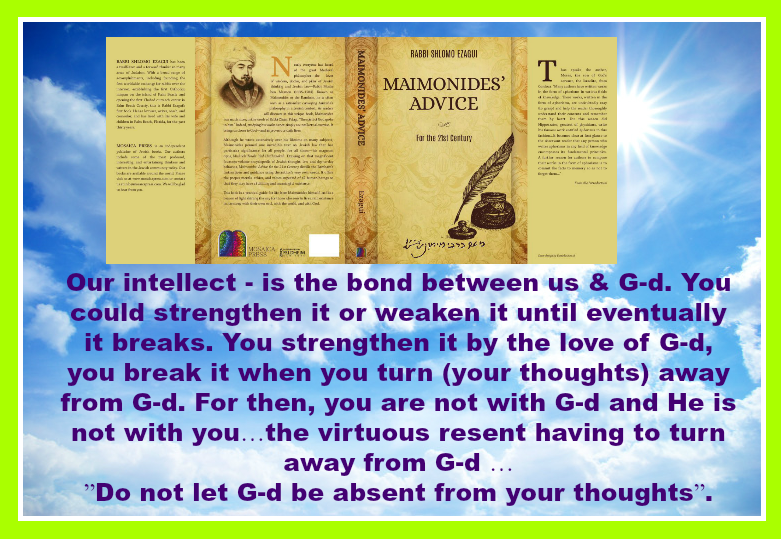
Maimonides Advice soon coming out in Print.